Friday, March 11, 2011

Spring Northern California Deals

Some tempting San Francisco and northern California packages and deals have appeared recently as hotels and destinations amp up their promotions for the spring and summer. Here are a few of the most interesting:

*In honor of Earth Day April 22 several California wineries are having special events through April.  A sample includes Concannon Vineyards in the Livermore Valley, offering free daily tours of the vineyards and $5 tasting flight of special wines, sourced from its vineyards which were placed in a trust to protect them from urban development. Grgich Hills Estate in the Napa Valley is conducting two-for-one biodynamic estate tours and tastings. Kunde Family Estate in the Sonoma Valley arranged a special “Hike and Taste” tour of its “sustainably certified” vineyards. And, four wineries of the Santa Cruz Mountains Organic Wine Trail are pouring their organic wines. For a complete list of events and deals see www.discovercaliforniawine.com 

*The Sonoma Creek Inn, which is near the Sonoma Mission Inn outside the town of Sonoma, is discounting stays by 40% for the month of April. Room rates begin at $71.40 Sunday through Thursday nights and $107.40 on weekends.  Those rates include tasting passes to local wineries and a complimentary upgrade at check-in if available. Over in Napa Valley, The Mount View Hotel and Spa in Calistoga put together an eco-friendly weekend getaway package called “Relax, Renew and Cycle” starting at $399 per couple, Sunday through Thursday.
 
*Two San Francisco hotels near the bayfront also have come up with new packages. The Hyatt Regency San Francisco, within walking distance to the AT&T Park (home of the World Champ Giants for those who slept through last fall), continues to celebrate the 2010 Giants victory. Its “20 Paces to the Bases” package includes accommodations, a $20 food and beverage credit at the hotel and a $25 gift card to the Giants’ Dugout team store. The price starts at $209 per room. At 15-minute walk north along the waterfront, the Fisherman’s Wharf Hyatt created a package called “Awaken” with rates starting at $219 and including a full breakfast for two people in the hotel’s Knuckles restaurant. And the hotel also has a "Home Run" plan, celebrating the Giants, with two all-day MUNI passes to take the F-Line to the park, appetizers at Knuckles and rates starting at $164 (this package is bookable only through April 30).


Wednesday, February 23, 2011

San Francisco's (Snow-Covered?) Hills

Strange as it may seem (particularly to those who live in cold weather climates), everyone seems to be talking excitedly about the possibility of snow this week in San Francisco.
It was even mentioned on the NBC Today show this morning: Snow may fall in the city -- for the first time in 30 years -- Friday night or Saturday, particularly in spots 500 feet above sea level.
San Francisco's elevation is generally listed at around 63 feet, but its many hills actually range in elevation from 100 to 928 feet, according to the San Francisco Visitors' Planning Guide, which I picked up today the San Francisco Travel Association.
(The association, the city's tourism promotion agency, was known for decades as the San Francisco Convention and Visitors Bureau. It changed its name a few weeks ago, dropping "bureau," which sounded, well, bureaucratic, executives there said).
One fascinating page in the guide is devoted to "San Francisco's Steepest Streets." Here are a few tidbits to keep in mind as we look upward in the coming days for signs of flurries:
*The actual number of hills in the city is highly contested, but counts range from 42 to 74, depending on who is doing the counting.
*San Francisco was originally built on seven hills, just like Rome. They are Telegraph Hill, Nob Hill, Russian Hill, Rincon Hill, Mount Sutro, Twin Peaks and Mount Davidson.
*Some of the city's hills are so steep that roads can't be built on them. More than 300 stairways provide access for residents.
*San Francisco's steepest streets are Filbert between Leavenworth and Hyde and 22nd Street between Church and Vicksburg. Both have a 31.5% grade.
Let it snow!

Thursday, February 3, 2011

News from Three Northern California Getaways

Every year, new attractions and places to explore seem to open up in northern California, and this year is no different. I met with a few destination marketers this week at a California tourism promotion event in San Francisco and picked up some newsy tidbits for northern California weekend getaways.

***In Calaveras County, two new tour companies are taking visitors into the area's many vineyards in different ways: by bike and horseback. A company called Horse and Barrel saddles up in the cute-as-a-button Gold Country town of Murphys -- home of 16 tasting rooms on Main Street -- and leads riders through local vineyards. Wine tasting comes after the horses are back in the barn. A similar concept is behind Get On Your Mark, a Calaveras County outfit founded by a USA certified cycling coach. These "wine" bike adventures feature bike rides through the rural Calaveras countryside and vineyards, lunch and, after the ride, wine tasting to cap it off.


***Up in El Dorado County, home of Coloma, the gold discovery site, tourism promoters are cheering the recent acquisition by the American River Conservancy of the 272-acre Gold Hill Ranch. This is a little-known historic site, just a mile south of Coloma and the Marshall Gold State Historic Park (about 40 miles north of Sacramento).

The ranch was first settled by Japanese from Aizu Wakamatsu, a region of Japan, in 1869. It is the birthplace of the first naturalized Japanese-American and the only community established by samurai outside of Japan. The Japanese who lived here started silk worm farming and cultivated tea, rice, citrus, peaches and other stone fruit. The National Park Service recently placed the site -- called Wakamatsu Colony -- on the National Register of Historic Places at a level of "national significance." Plans are in the works to open 19th century farmhouses and acres of beautiful hilly and oak-dotted land to the public.

***In Santa Cruz, two landmarks are celebrating milestones in 2011. The Mark Abbott Memorial Lighthouse opened 25 years ago to commemorate a young surfer who lost his life to the sport. The small red-brick building, perched on the cliffs overlooking the crashing waves of the Pacific Ocean, is home to the Santa Cruz Surfing Museum. Several of the original long-board surfboards (some made from redwood planks) from the early days of surfing hang from the walls. Other exhibits include surfing industry legend and pioneer Jack O'Neill's prototype wetsuits.

A few minutes' walk away at the Santa Cruz Beach Boardwalk, the beautiful old carousel turns 100 this year.  One of the few remaining carousels in the U.S. with an actual brass ring, riders of one of 72 hand-carved horses and colorful chariots can try to reach it as they pass. The other boardwalk historic landmark -- the thundering Giant Dipper wooden roller coaster -- has a few years to go before its centennial. It opened in 1924.

Thursday, January 13, 2011

SF Eats: It Sure Did and Still Does

Anyone who has lived in San Francisco -- or eaten in San Francisco -- for a decade or more may feel pangs of nostalgia at the San Francisco Public Library's main branch at Civic Center these days. The exhibition, San Francisco Eats, on display through March 20, traces the history of the city through its food-obsessed culture.
Long before the term "foodie" was coined, people were crazy about eating in San Francisco and this exhibit shows why.
Who couldn't resist Fisherman's Wharf when it was lined with crab shacks and fishermen eating elbow to elbow with the locals? Or more elegant places to dine, such as the Fior d'Italia, Trader Vic's and the Cliff House?

The displays of old menus, historic photos and cookbooks are nicely shown in two areas, the Skylight gallery on the library's top floor and the Jewett gallery on the bottom floor.
The Jewett exhibit focuses on ethnic neighborhoods -- the Mission, North Beach and Chinatown -- and the impact of immigration on San Francisco dining.
The top floor gallery has a large collection of old restaurant menus, which are charming for their delightful graphics and interesting for their content. It looks as if calf brains (a nickel for a plate) and frog legs were standard menu items back in the late 1800s and that it was common for a fish restaurant to have a section on "casseroles" -- which seemed to consist of fish baked in a cheesy au gratin style.
An old Fish Grotto menu lists dishes such as Baked Barracuda and the meager cheese selection (only five choices, two of them are Swiss and Monterey cheese) made me pause and appreciate living in the 21st century.
There's a lot of attention paid to San Francisco restaurants that have passed the 100-year mark (the Fior, Tadich, Sam's, among them). The earliest menu is from a restaurant called The Ward House from 1849 and one of the non-menu items on display is a roasted peanut wagon that the Houtalas', the Greek immigrant family that first managed the Cliff House, operated along Ocean Beach in 1906.
The library has scheduled San Francisco Bites, food-oriented movie screenings and panel discussions in conjunction with the exhibit. The next presentation is on Tuesday, Jan. 18 at 6 p.m. when a panel of local food bloggers will talk about the city's neighborhoods, the foraging phenomenon and today's changing food culture, followed by a Q&A session. The main library is at 100 Larkin Street at the corner of Grove. The phone is 415-557-4277.

Friday, January 7, 2011

Updated San Francisco Travel Apps Released

In time for San Francisco Chinatown's annual big event -- New Year's -- my Chinatown travel guide app for iPads, iPhones and iPod Touches has been updated and released by Sutro Media with more photos and information on places to see, where to eat and shop in this most historic of the city's neighborhoods.

This year's festivities -- celebrating the Year of the Rabbit -- kick off on Saturday, Jan. 29 at 10:30 a.m. with a procession of lion dancers, bands and local dignitaries starting at St. Mary's Square and following the original parade route -- down Grant Avenue -- first established in the 1860s.

Of course, the big deal comes a few weeks later -- this year on the evening of Feb. 19 -- when the Chinese New Year's parade, sponsored by Southwest Airlines, makes its way from downtown to Chinatown, a brightly-colored 250-foot-long Golden Dragon capping it all.  It's the largest celebration of Asian culture outside of Asia, and hundreds of thousands watch the spectacle (even in chilly, rainy weather).

My second San Francisco travel guide app, North Beach and Fisherman's Wharf  was also just updated and rereleased with more entries and photos, including the newish bar and restaurant, Comstock Saloon, which combines a taste of the city's old Barbary Coast (it's named after Henry Comstock and the famous Comstock Lode) and today's trendy "mixologist"  cocktail culture in one swell place (my favorite spots are the booths along the wood-paneled bar's walls). Check out the apps by clicking on the links above or searching on iTunes (under Travel and San Francisco). Enjoy them on your iPhone, iPad or iPod Touch.

Monday, December 13, 2010

Downtown Napa Revival Well Underway

 Downtown Napa used to be a sleepy place, with working-class roots that set it apart (some might say pleasantly so) from its increasingly chic and expensive "up valley" neighbors: Yountville and St. Helena. But these days Napa is turning into every bit the wine country destination. With about $700 million in public and private investment flowing into downtown, Napa is abuzz with more than a dozen new restaurants, several luxury hotels, wine tasting rooms, a refurbished theater and opera house, a public market and a sleek riverfront residential and commercial district.
   It's all due to a flood control project to tame the Napa River, which overflowed its banks to disastrous
 effect several times in the last 100 years, the most recent time in 1986 causing $200 million in damage. The project transformed the river, restoring the natural habitat at its shores, creating a curved channel and opening space for development. Celebrity chef Masahuru Morimoto of Iron Chef fame opened his $5 million restaurant, Morimoto along the riverfront last year.
Other notable downtown restaurants have drawn much attention: La Toque, which was recently awarded a Michelin star; Bradley Ogden's Fish Story; Angele; Oenotri, a southern Italian pizzeria; Ubuntu, a vegetarian restaurant combined with yoga studio; and Greg Cole's Celadon, one of the older of the newbies (it opened in the 1990s and later moved to the historic riverfront Hatt building).
The latest addition to the dining scene is by Food Network star Tyler Florence, who opened Rotisserie & Wine, earlier this month.
Just a few blocks from the river, in an area now called the "West End," upscale boutique hotel Avia (photo below) made its debut in July 2009, bringing a sophisticated addition to downtown with its 58 "tub suites" with in-room soaking tubs for two and a large terrace with comfortable chairs for lounging around firepits on cool wine country evenings.
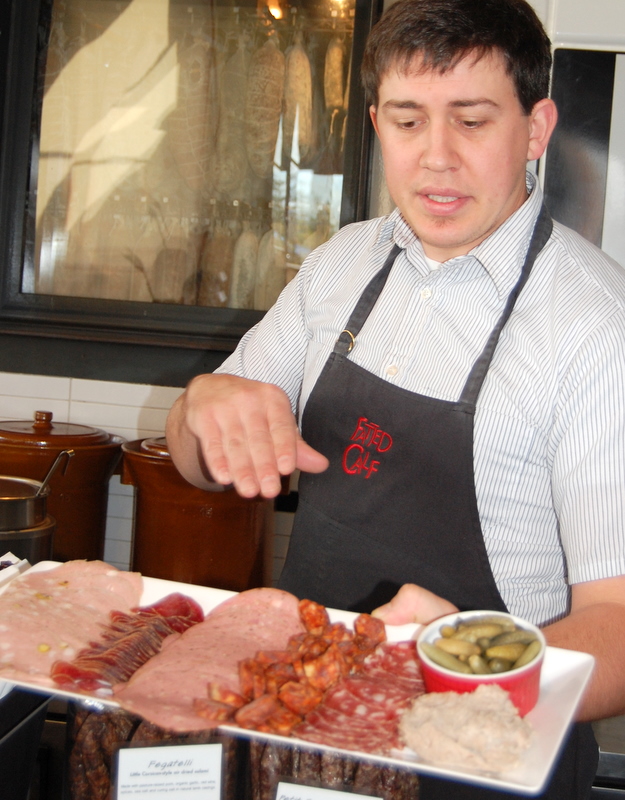
I hadn't been to the Oxbow Public Market (top photo) for a couple of years -- since a disappointing visit when I found little of the bustle that makes such food halls so much fun to explore. This time was different. All the food stalls are rented out and even on a wintry weekday morning there was a lot of energy in the air, tables full of diners. The range of eateries and food available is impressive: Hog Island Oysters, the Oxbow Cheese Merchant, Ritual Coffee Roasters, The Olive Press, The Fatted Calf artisanal charcuterie (middle photo), Napa's decades-old Model Bakery, Kara's Cupcakes and a newcomer, Ca'Momi, an Italian-run pizzeria with an excellent and authentic pastry selection (a third-generation pastry chef from Tuscany is visiting for several months and his custard-filled cream puffs are delicious).
I walked through downtown Napa's historic district with George Webber, who conducts fascinating two-hour tours, and then poked through market and some local wine shops with Andrea Nadel of Gourmet Walks, a company that offers walking tours that include visits with chefs and artisan food producers. My two-day trip to downtown Napa was sponsored by the Napa Downtown Association, which is eager to show off the revitalized area. Check out its downtown visitors center where you can buy Taste Napa Downtown, a $20 card that allows users to sample wines at 14 tasting rooms within walking distance. Included are notable Ceja Vineyards (one of few Mexican-American-owned California wineries) and GustavoThrace (one of the growing number of women-owned wineries).

Tuesday, November 30, 2010

Big Sur's New Discovery Center

 Just 20 miles south of Carmel and not far from the much-photographed Bixby Bridge (top photo) lies Andrew Molera State Park, one of Big Sur's most accessible hiking areas. The gentle, flat camp trail of only a couple of miles follows the Big Sur River and leads past campsites to a long, curved beach and a secluded cove nestled against high bluffs. Also along the camp trail is the Cooper Cabin, built in the 1860s and the oldest structure in Big Sur. Early settler Molera ran his dairy farm here, producing some prized Monterey Jack cheese.
(Check the park's website for latest on trail conditions because there's some work being done on the trails this winter and a seasonal footbridge over the river was not up when I visited in late November).
The park is a 4,800-acre swath of wilderness with meadows, oak and redwood groves, wildlife and beautiful three-mile-stretch of Pacific coastline where you may spot sea lions, sea otters and migrating whales.
Andrew Molera also includes a quaint old farmhouse, picnic area and fruit orchard that's open to the public where you can see how the early settlers, cattle ranchers and dairy farmers lived. And, I learned on a visit last week, the park has a new addition, the Ventana Wildlife Society's Discovery Center, which opened in the last couple of years in a restored old barn near the farmhouse and park entrance.
This local non-profit group, dedicated to native wildlife and their habitats, worked to reintroduce the bald eagle to central California. Restoring the wild population of California condors is now the society's focus and the center has several interactive exhibits on these ugly-but-fascinating animals, which are the largest flying birds in North America, their wing spans reaching more than nine feet. If you've wondered where best to see them and how to identify them, this is the place to go (hint for identifying them: there are white or mottled triangles under their wings, unlike turkey vultures). Who knew that condors mate for life, have no vocal chords and can live for 50 to 60 years?

Thursday, November 4, 2010

Oh-so-Sweet Victory for the San Francisco Giants!


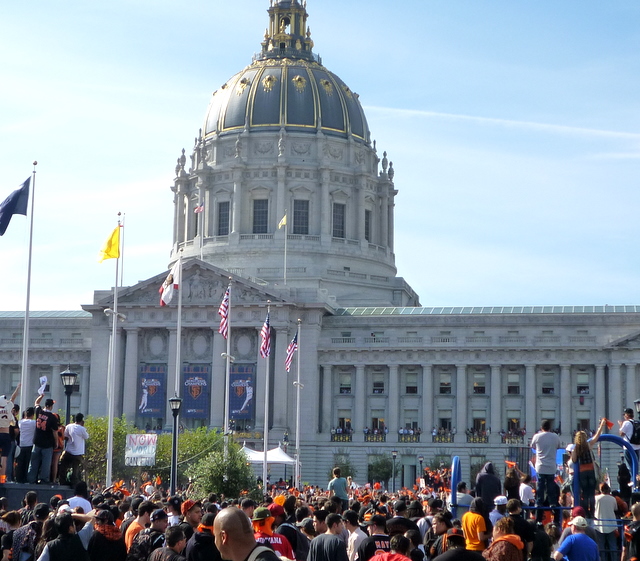
What an amazing week in San Francisco!