Monday, December 13, 2010

Downtown Napa Revival Well Underway

 Downtown Napa used to be a sleepy place, with working-class roots that set it apart (some might say pleasantly so) from its increasingly chic and expensive "up valley" neighbors: Yountville and St. Helena. But these days Napa is turning into every bit the wine country destination. With about $700 million in public and private investment flowing into downtown, Napa is abuzz with more than a dozen new restaurants, several luxury hotels, wine tasting rooms, a refurbished theater and opera house, a public market and a sleek riverfront residential and commercial district.
   It's all due to a flood control project to tame the Napa River, which overflowed its banks to disastrous
 effect several times in the last 100 years, the most recent time in 1986 causing $200 million in damage. The project transformed the river, restoring the natural habitat at its shores, creating a curved channel and opening space for development. Celebrity chef Masahuru Morimoto of Iron Chef fame opened his $5 million restaurant, Morimoto along the riverfront last year.
Other notable downtown restaurants have drawn much attention: La Toque, which was recently awarded a Michelin star; Bradley Ogden's Fish Story; Angele; Oenotri, a southern Italian pizzeria; Ubuntu, a vegetarian restaurant combined with yoga studio; and Greg Cole's Celadon, one of the older of the newbies (it opened in the 1990s and later moved to the historic riverfront Hatt building).
The latest addition to the dining scene is by Food Network star Tyler Florence, who opened Rotisserie & Wine, earlier this month.
Just a few blocks from the river, in an area now called the "West End," upscale boutique hotel Avia (photo below) made its debut in July 2009, bringing a sophisticated addition to downtown with its 58 "tub suites" with in-room soaking tubs for two and a large terrace with comfortable chairs for lounging around firepits on cool wine country evenings.
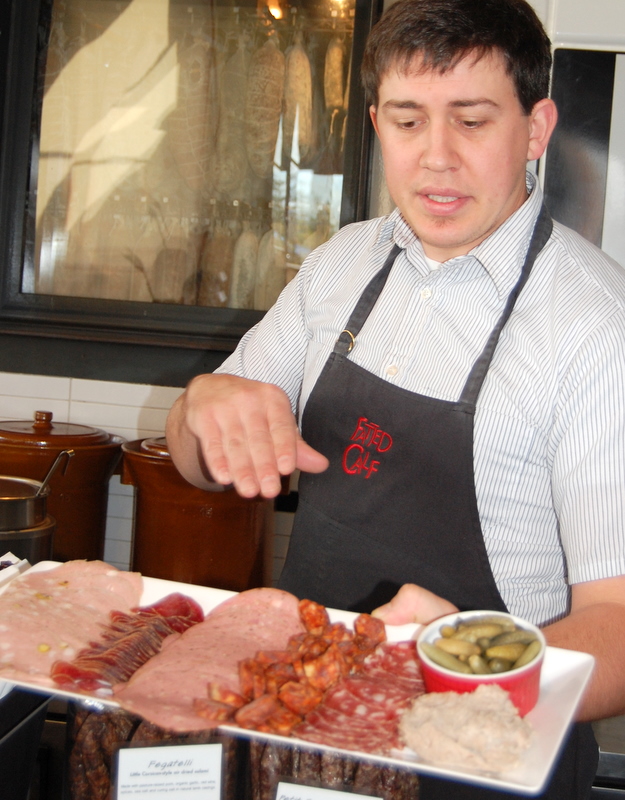
I hadn't been to the Oxbow Public Market (top photo) for a couple of years -- since a disappointing visit when I found little of the bustle that makes such food halls so much fun to explore. This time was different. All the food stalls are rented out and even on a wintry weekday morning there was a lot of energy in the air, tables full of diners. The range of eateries and food available is impressive: Hog Island Oysters, the Oxbow Cheese Merchant, Ritual Coffee Roasters, The Olive Press, The Fatted Calf artisanal charcuterie (middle photo), Napa's decades-old Model Bakery, Kara's Cupcakes and a newcomer, Ca'Momi, an Italian-run pizzeria with an excellent and authentic pastry selection (a third-generation pastry chef from Tuscany is visiting for several months and his custard-filled cream puffs are delicious).
I walked through downtown Napa's historic district with George Webber, who conducts fascinating two-hour tours, and then poked through market and some local wine shops with Andrea Nadel of Gourmet Walks, a company that offers walking tours that include visits with chefs and artisan food producers. My two-day trip to downtown Napa was sponsored by the Napa Downtown Association, which is eager to show off the revitalized area. Check out its downtown visitors center where you can buy Taste Napa Downtown, a $20 card that allows users to sample wines at 14 tasting rooms within walking distance. Included are notable Ceja Vineyards (one of few Mexican-American-owned California wineries) and GustavoThrace (one of the growing number of women-owned wineries).

Tuesday, November 30, 2010

Big Sur's New Discovery Center

 Just 20 miles south of Carmel and not far from the much-photographed Bixby Bridge (top photo) lies Andrew Molera State Park, one of Big Sur's most accessible hiking areas. The gentle, flat camp trail of only a couple of miles follows the Big Sur River and leads past campsites to a long, curved beach and a secluded cove nestled against high bluffs. Also along the camp trail is the Cooper Cabin, built in the 1860s and the oldest structure in Big Sur. Early settler Molera ran his dairy farm here, producing some prized Monterey Jack cheese.
(Check the park's website for latest on trail conditions because there's some work being done on the trails this winter and a seasonal footbridge over the river was not up when I visited in late November).
The park is a 4,800-acre swath of wilderness with meadows, oak and redwood groves, wildlife and beautiful three-mile-stretch of Pacific coastline where you may spot sea lions, sea otters and migrating whales.
Andrew Molera also includes a quaint old farmhouse, picnic area and fruit orchard that's open to the public where you can see how the early settlers, cattle ranchers and dairy farmers lived. And, I learned on a visit last week, the park has a new addition, the Ventana Wildlife Society's Discovery Center, which opened in the last couple of years in a restored old barn near the farmhouse and park entrance.
This local non-profit group, dedicated to native wildlife and their habitats, worked to reintroduce the bald eagle to central California. Restoring the wild population of California condors is now the society's focus and the center has several interactive exhibits on these ugly-but-fascinating animals, which are the largest flying birds in North America, their wing spans reaching more than nine feet. If you've wondered where best to see them and how to identify them, this is the place to go (hint for identifying them: there are white or mottled triangles under their wings, unlike turkey vultures). Who knew that condors mate for life, have no vocal chords and can live for 50 to 60 years?

Thursday, November 4, 2010

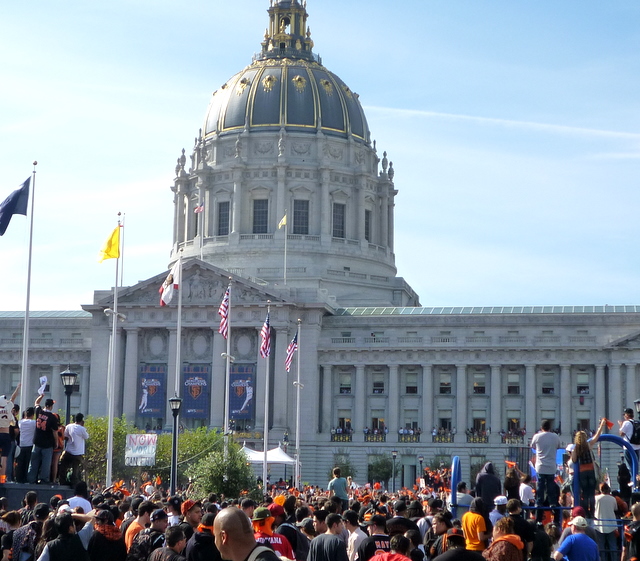
Oh-so-Sweet Victory for the San Francisco Giants!


What an amazing week in San Francisco!

Wednesday, October 13, 2010

San Francisco's Ferry Building Tour Receives Accolades


The Ferry Building, Saturday morning
 My tour of San Francisco's Ferry Building and the Embarcadero was recognized this week with a bronze award in the audio travel broadcast category of the Society of American Travel Writer's annual Lowell Thomas travel writing awards.
The timing couldn't have been better: today the Ferry Building was named one of the 10 "great places" of the year by the
American Planning Association.
My tour was produced by Visual Travel Tours, a California company that offers downloadable programs for mobile devices covering travel destinations all over the world.
I wrote the script and took the photos of the Ferry Building and Embarcadero waterfront, an area that has undergone a renaissance the last 10 years (the voice on the audio tour is a professional broadcaster, however, not me).
The judges had some nice things to say about the tour: "Laura Del Rosso introduces old-fashioned tourism to the full power of modern multimedia. She has produced an elaborate but easy-to-understand travel guide to San Francisco that you can put in your computer -- save on your iPod -- or simply slip into your pocket stored on your cell phone. Wherever you keep it, you'll be glad you have it....It's the closest equivalent you'll find to having a good friend show you around a city she loves. Travel can be tricky. With Del Rosso's guide, it should be a treat, instead."

MUNI's historic F-Line streetcar
 The tour, which is designed as a two- to three-hour stop-and-start walking tour, covers the Ferry Building and its food hall, the farmers' markets and the Embarcadero waterfront north and south of the landmark building, with a special focus on the history of the area going back to the Gold Rush.
The tour can be purchased in four ways: 1) in text and photos for print 2) photos and text for mobile devices 3) an audio-visual tour for mobile devices and 4) a complete package, including a CD. Enjoy!

Wednesday, September 15, 2010

September is Wine Month

Not only is September harvest season in the wine country but it's also officially California Wine Month (as proclaimed by Governor Arnold Schwarzenegger). It's the seventh year for the wine month promotion, which showcases the state's mind-boggling array of wine regions.

The California Wine Institute, a trade organization of the state's winemakers, is behind the event. It created a lovely, useful web site with lots of great information on the state's wine areas and wineries.

At a promotional event last night, I spoke with Jim Ryan of Concannon in the Livermore Valley, one of California's less well-known wine areas. Ryan said the valley -- where grapes were first planted in 1854, long before Napa -- is getting better known, in part thanks to the economy that's keeping people closer to home and looking for bargains. Places like Livermore are where the wine values are to be found. "We've got great values and it's location, location, location." It's a relatively fast drive from many places in the Bay Area: without much traffic it takes only 45 minutes from San Francisco. And, tasting rooms don't cost as much as at the state's more famous competing wine zones: typical Livermore valley wineries charge $5 for sampling seven wines. At Concannon, you even get to keep the glass.

Evan Goldstein, master sommelier, gave a talk on the importance of California wines. "We take it for granted at times," he said. California is critical in the U.S. wine industry, with nine out of 10 bottles produced In the U.S. from the state. Forty-eight out of California's 50 counties grow grapes. Goldstein said wine lovers are getting more adventurous about visiting more of the state's wine regions and trying different types of wines, beyond standard merlot, cabernet, sauvignon blanc. "We've got more than 100 types of grapes grown commercially in California and lots of different appellations." That's lots of opportunities to explore.
(Photos: at top left, Domaine Chandon. At right, a vineyard in spring, outside Healdsburg).

Tuesday, September 7, 2010

Al Fresco Dining Weather (Finally) Arrives

The coldest summer in memory didn't put a damper on one of the best new events in San Francisco: Off the Grid. It's part of the food cart/truck movement that offers relatively inexpensive street food in a sort of roving festival of brightly-colored vehicles. Think really cool taco trucks. On Friday evenings, Off the Grid hits the Fort Mason parking lot 5-9 p.m.

It's kind of a funny scene: A couple dozen of the trucks circle like wagon trains. In the middle there's a bar, some tables and folding chairs, although not nearly enough. Even though it's held in a bayside spot where fog and wind whip through, the event draws hundreds of people. One recent blustery, cold evening that called for wool hats and fleece jackets 4,000 crammed into the truck circle over a four-hour period. Lines were long but everyone seemed to be having a good time.


And, Friday nights' Off the Grid should become even more pleasant during warmer September and October evenings.
Some of the most popular food trucks are Chairman Bao, which specializes in steamed and baked buns, Hapa Ramen, dishing up noodle soup using local and organic ingredients, Calidogs, offering unusual varieties of spiced hot dogs, and the Creme Brulee Cart, serving up little cups of this warm, custardy dessert, comforting on a chilly night. Off the Grid is arranging other food cart events and some of the food cart operators are active on Twitter: if you become hooked on a certain dish (and it sounds like lots of San Franciscans have), you can hunt down the cart and follow it around town.
For more civilized al fresco dining (table service and no lines!) I spent a lovely morning having brunch with friends on the small and charming patio at the rear of the Blue Jay Cafe on Divisadero, which serves wonderful fried chicken and waffles. I've always loved the atmosphere at this American-style diner with its big horseshoe-shaped counter, but hadn't stepped out back. There are only three or four tables, but it's warm and cozy, with tall brick walls and big red umbrellas providing shade. The food is reasonably priced ($7.25 for the chicken and waffles) and there's a lot of down home southern flavor, with biscuits and corn muffins always on the menu.

Friday, August 20, 2010

Quick Healdsburg Nosh-and-Coffee Break

On my way to Mendocino recently from the Bay Area I stopped in the Sonoma wine country town of Healdsburg to stretch my legs and grab a quick lunch. Usually, I head to the swell Oakville Grocery right off the square but I'm on a budget these days so I decided to look around for something less dear.

Friends in the area have raved about Big John's, the high-end supermarket about a mile north of the town square. I headed over there, finding one of those independent, old-fashioned grocery stores with warm and friendly service and a big assortment of local produce, fruit and products -- Redwood Hill Farm cheese, Sonoma County olive oils, mustard and jam -- which make wonderful souvenirs to bring home from a trip to the wine country. Prices are probably less than you'll find at fancy winery gift shops.

I later learned that the "Big" in Big John's doesn't refer to the girth of the owner but is an acronym for Better Independent Grocers and that the store is not the decades-old institution that I assumed but actually relatively recent to these parts, having opened in 1994.

With a turkey-and-tomato sandwich on sourdough (for less than $7), some juicy local nectarines and a bottle of water I headed back the Healdsburg square for a quick picnic in the shade of redwoods.

Then, to keep me alert for the drive ahead, I headed to Flying Goat Coffee (right off the square) for a strong and rich macchiato. I picked up a gift for my hosts in Mendocino County -- a pound of Flying Goat's most popular roast, Mrs. Garland's Blend, forgetting that I was traveling to Thanksgiving Coffee Co. territory.

We'll let fans of Sonoma County's Flying Goat and Fort Bragg-based Thanksgiving, which is beloved on the north coast and by my friends in Mendocino County, battle it out. It's remarkable that we've got such choices in good coffee in these parts.

Monday, August 2, 2010

Point Richmond's Plunge Set to Re-Open

Maybe you've heard: The Plunge, the largest swimming pool in California, is reopening in Point Richmond.

The huge pool, built in 1926 in a handsome building on the railroad tracks on the edge of town, was closed in 1997 and now, after a $7.5 million renovation, is scheduled to re-open on Aug. 14 with a celebration ribbon cutting and tours. I walked outside on Saturday and workers were putting the finishing touches on the place, which houses the 9,600-square foot pool. From the looks of it, the Richmond Municipal Natatorium, as it's officially named, will be pretty swell, like it was in its heyday when it was known as the East Bay's version of San Francisco's Sutro Baths.

The Plunge is just one claim to fame of Point Richmond, a lovely place to spend an afternoon. A few good restaurants dot the streets around the central square, which is called The Triangle because it's not in the shape of a square. There's a new farmers' market Wednesdays 4 p.m.-8p.m. there that sounds worth a visit.

A couple of art galleries and gift shops surround the triangle, many housed in early 20th century buildings, restored and pretty spiffy. A friend and I fell into Hidden City Cafe not realizing it's THE place to eat in town. It's a nice little spot with a red-brick facade and, true to its name, is hard to find unless you are walking right in front of it.

The owner and chef is Shellie Bourgault, formerly of Chez Panisse. As you'd expect, she uses wonderful organic, fresh ingredients. I had the polenta scrapple with eggs and toast -- panfried wedges of polenta spreckled with pieces of Hobb's applewood bacon and herbs -- that was delicious. I've got to go back and try the pancakes, which I learned later Hidden City is famous for (it's only open for breakfast and lunch). Also, apparently, this is a favorite lunch spot of the animators at Pixar Studios: Hidden City's exterior was used in a scene in the movie Wall-E.

If you're going to check out Point Richmond, walk around the town a bit.

In front of The Plunge is one the last remaining wigwags, the old railroad crossing warning systems, now decommissioned. Turns out that there's quite a cult following of wigwags and efforts to remove them set off alarms (sorry, couldn't resist) from wigwag enthusiasts. I even found a youtube video of the Point Richmond wigwag, prior to its decommissioning (check out the brave -- or foolish -- bikers!). There IS something kind of endearing about them.

Several pretty old churches that date from the early 20th century were built on Point Richmond's hills. They are on leafy residential streets sandwiched in between old homes, some rather stately. After, get back in your car and take a right at The Plunge and drive through the Ferry Point Tunnel. The walking trails at Miller/Knox Regional Shoreline and saltwater lagoon make for a good after-lunch stroll. And, there's small, sandy Keller Beach nearby to dip your toes in the bay.