Tuesday, September 17, 2013

Retro Russian River


I've spent much of the summer up at Sonoma County's Russian River, which seems to undergo transformations every few years (the latest is an influx of San Francisco-style hipsters, including some fine chefs). But some things never change.

Take Johnson's Beach, where the annual Jazz and Blues festival is happening this weekend. You can still drive down to Johnson's and park for free.You can spend a lazy day on the river's rocky shore. Bring a picnic and nibble all day. Wander over to the snack bar for a beer and a burger, splash in the water and, when the sun gets too hot, rent a big beach umbrella and have one of the young staffers set it up for you.

You also can rent inner tubes, paddle boats, canoes or kayaks and paddle under Guerneville's two side-by-side bridges (the old one from the 1920s is pedestrian-only).
Inner tubes are big at the river and may be the most fun. Kids get a bunch of them, stack them up and plop around for hours.

Hamburgers and hot dogs are only $3 and a big vanilla Frostie soft ice cream cone is $2.

It's still a family-run operation as it has been since 1918. At the snack bar is 92-year old Claire Harris,who cheerily serves up beer and rents the canoes and kayaks. Just like when I was a kid, a while ago.

And, from chatting with others, it's a generational thing: people came here as kids and bring their kids and grandkids to Johnson's today. Maybe it's the old-time atmosphere but even teenagers seem to pick up the vibe: you don't see them glued to their smartphones and electronic gadgets.
Around 6 p.m. Claire gets on the loudspeaker and announces that it's quitting time.
Then he puts on the sweet old tune "It's Only a Paper Moon" which is background music as the crowd, including tired, sunburned kids and slow-moving adults who reluctantly rise from chairs and sleepily from their towels, makes its way up the dusty hill to head back to their cars and to home.


Tuesday, July 16, 2013

Edible Oakland: Temescal Treats

Edible Excursions, which has been exploring San Francisco neighborhoods and finding the most interesting and delicious food offerings for several years, expanded to Oakland's Temescal recently and its timing couldn't have been better.
Lisa Rogovin, the company's founder, has been running regular San Francisco tours and in the East Bay in North Berkeley's Gourmet Ghetto but the new programs to Temescal cover a burgeoning food mecca not yet known to many Bay Area foodies. It won't stay that way for long.
By the month it seems new eateries are springing up along Shattuck and Telegraph avenues in this once-blighted area that is drawing refugees from San Francisco's high rent districts.
The tour has already gotten favorable national press, including in Forbes, and in local media.
On a recent Sunday morning, I joined Edible Excursions at the bustling Temescal market, one of several Urban Village Farmers Markets, in the DMV parking lot at 5300 Claremont Ave., where we sampled the spectacular Kouign Amann, a delectable croissant-like French pastry, from Starter Bakery (upper left) and tasty fish tacos and agua fresca from Cholita Linda stands.
Then it was onto the streets of Temescal, where Sunday mornings are quiet but you nonetheless get a feel for how the area has been transformed with the spruced up storefronts along Shattuck and Telegraph.
Along a row of former Oakland fire department horse stables on 49th street is a charming lane called Alley49 lined by several very hip and cool places to stop, including pint-sized The Cro Cafe, which serves shots of strong, dark Sightglass Coffee, and Doughnut Dolly (right), where friendly servers fill scrumptious doughnut holes with cream or jam to order as you wait.
The main drag of Telegraph along Temescal has some wonderful well-known restaurants and eateries, including Bakesale Betty, Pizzaiolo, Dona Thomas and Genova Deli (where the lines are long but whose artichoke frittata has no equal).
Save those for later: this tour focuses on newer and lesser-known places.
You'll sit a while at cozy two-year-old Sacred Wheel, a cheese and specialty market that offers Virginia country ham, and have a half of grilled cheese sandwich with a small bowl of tomato soup. Then you'll hit several ethnic restaurants, including the colorful new Juhu Beach Club, where chef Preeti Mistry uses local and organic produce to serve up savory Mumbai street food based on her mother's recipes.
Temescal has been home to wave after wave of immigrants (a few remnants of mid 20th century Italian-American community remain, including Genova Deli and an Italian social club) and more recently it has drawn thousands of Ethiopians and Koreans. There's a mind-boggling array of ethnic restaurants to choose from.
The tour stops at Abesha, where participants mingle with Ethiopians stopping in for lunch after church, indulging in a variety of appetizers, such as sambussas (pastries filled with lentils, onion and peppers) and the traditional Ethiopian spicy stews of meat and vegetables scooped up with injera, the sponge-like bread.
At Sura Korean, which opened in 2007 and specializes in natural ingredients and lighter fare than standard Korean restaurants, we dove into a large sampling of kimchee (photo at right) and an outstanding tofu soup and then headed back out to the warm Oakland sun to explore a bit more on our own before heading home.
Edible Excursions' Temescal Tastes tour operates Sunday mornings 11 a.m.-2 p.m.
The cost is $75 per person. Check it out to discover this up-and-coming neighborhood that you'll be hearing a lot about in the coming years.

Wednesday, April 24, 2013

Point Bonita Lighthouse on a Full Moon Evening

Tunnel leading to the lighthouse
There are bucket lists for the big events and adventures in life and then there are lists of things to do locally that you never seem to get to: visiting Point Bonita Lighthouse was one for me.  This winter -- on a crisp, clear evening when a golden full moon rose over San Francisco -- I joined a group for the Golden Gate National Recreation Area's monthly evening walk to the lighthouse. It's an adventure, about a half-mile walk down a steep cliff-side trail from a remote Marin headlands parking lot that itself seems perched on the edge of the continent.
But it gets better. You walk through an 118-foot hard-rock tunnel, hand carved by workmen in the late 1800s and reach another point where a white suspension bridge stretches over a gap in the cliffs, the surf pounding far below.
The park service recommends dressing warmly and bringing a flashlight and that can't be emphasized enough. It's cold out there and, even with a bright moon glow, it's dark after sundown.
The views are awesome and unforgettable, with the the lights of the Golden Gate Bridge and San Francisco to the east, the coastline extending south to Half Moon Bay and beyond  and the vast, sparking Pacific to the west. 
There's much fascinating history to learn about, including the lives of the lighthouse keepers, but much of it is grim: the many shipwrecks in the treacherous fog, sometimes so dense that even the lighthouse's powerful lens was invisible from below. 
The lighthouse, built in 1877, is still in use today, operated by the U.S. Coast Guard. It's the only lighthouse in the U.S. to be reached by suspension bridge, a narrow strip that sways with foot traffic (not for those prone to vertigo), rebuilt in the last two years. The crossing of the bridge, the crashing surf on the rocks and shore far below, is one of the memorable parts of the evening.
Docents who lead the monthly full-moon hikes describe the history, geology and the flora of the rugged landscape -- and they throw in an astronomy lesson when the stars twinkle in the evening sky.  
Point Bonita is also open for visits during limited daytime hours (Saturdays, Sundays, Mondays 12:30 p.m.-3:30 p.m.) but try to nab a spot on one of the full-moon walks. Make reservations a couple of months in advance because there is a 40-person limit and the groups fill up quickly. Apparently, it's on many Bay Area residents' local bucket lists, and for good reason.


Thursday, February 21, 2013

Fireworks, Drums, Dragons

It's the time of year for San Francisco's biggest celebration: the annual Chinese New Year parade this Saturday February 23, starting at 5:15 p.m. from Second and Market streets (up Geary, then Powell and Post) to Kearny and Jackson in the heart of Chinatown.

Expect almost 100 floats, marching bands, drum groups, fireworks, lions and, of course, the long colorful golden dragon to cap it all off in a San Francisco tradition that dates from the Gold Rush days.

Grant Avenue will be abuzz with a street fair 10 a.m. to 4 p.m. Saturday and 9 a.m. to 5 p.m. on Sunday, sidewalks along Stockton Street even busier than usual with holiday shoppers and cavernous dim sum restaurants packed -- all in celebration of the Year of the Snake.

My San Francisco Chinatown travel app -- a guide to the neighborhood's historic sites, shops, restaurants and old alleyways -- has been updated for the occasion with more photos and entrees than before. Maps, contact information and links to websites are included.

It's available for iPhones and iPads in iTunes and also in the Android store. (However, the updated Chinatown app won't be ready until March 2 for Android).


Gung Hay Fat Choy!


Wednesday, October 24, 2012

New in Northern California

Every October the California tourism industry meets with the media to showcase all that's new in the Golden State. This year was no different and the range of new attractions and events on tap for northern California is more than enough to get people out and about rain or shine the next few months. Here's a round up of some of the region's news:

*Yosemite National Park's  brilliant autumn foliage will be at its peak the next two or three weeks, said John Poimiroo, who produces a website devoted to California fall colors. Despite this week's storm that put a damper on some of the colors, "it's been a spectacular season so far. Leaves turned early and the colors have lasted a long time," he said.

*Yosemite will commemorate the 150th anniversary of the start of the national park movement through 2014 with symposiums, art exhibits, film festivals, concerts and more. In the midst of the Civil War -- on June 30, 1864 -- President Lincoln signed the Yosemite Grant Act to protect Yosemite and Mariposa Grove, a move which marks the creation of the U.S. national park system. Check the link for the anniversary events.

*Some people may not think vibrant nightlife when they think of Monterey County but it's there, says the Monterey County Convention and Visitors Bureau. The Attic, a watering hole that drew John Steinbeck and other local residents five decades ago has reopened. The owner is the original owner's grandson and bar goers sip drinks in the same place where Steinbeck and Doc Ricketts imbibed in a newly expanded space on Alvarado Street. Just a short stroll away Restaurant 1833 in a historic adobe attracts a lively crowd for cocktails.

*San Francisco's Pier 39 has a new thrill ride that combines ups and downs of a roller coaster (a simulated one) with an interactive shooting game. It's called the 7D Experience and it's all done in a digital theater with surround sound, 3D effects and laser technology. For the Halloween season this October, zombies are part of the action.

*The surfing movie "Chasing Mavericks" is being released this week and Santa Cruz is gearing up for a potential visitor bump as a result of the publicity. The movie tells the true story of local surfer Jay Moriarty, one of the youngest to compete in the big wave competition at Mavericks near Half Moon Bay on the San Mateo County coast. The Santa Cruz County Conference and Visitors Council has released a self-guided tour map with locations featured in the film.

*Sacramento's newly expanded Crocker Art Museum will show "The American Chronicles: The Art of Norman Rockwell" an exhibit of more than 50 paintings and 300 magazine covers of the American artist known for his Saturday Evening Post paintings of quaint American life. The show opens Nov. 10 and ends Feb. 3, 2013.

The Visit California website has more on what's new around the state.


Tuesday, September 18, 2012

SFJazz Gets Permanent Home

Anyone driving along Franklin Street around San Francisco's Civic Center and Hayes Valley lately has noticed it: lots of construction, particularly at the corner of Fell Street.
It's one of the most anticipated new builds of 2013: the home of SFJazz and the first concert space designed specifically for jazz on the west coast.
On a press tour recently, Randall Kline, SFJazz founder and executive artistic director, described the goal: providing a relatively intimate space, a cross between concert hall and nightclub, where music lovers and musicians can enjoy the full artistry of the music and performance.
And, for the first time, SFJazz will be able to present concerts in one free-standing space instead of rented venues around the city.
Last week, Kline announced the center's first season of programming, including the grand opening celebration on Martin Luther King Jr.'s birthday -- Jan. 23 -- billed as an "extravaganza" with McCoy Tyner, Chick Corea, Esperanza Spalding, Joe Lovano, Joshua Redman, Bobby Hutcherson, Mary Stallings, Rebeca Mauleon and the SFJazz Collective. Master of ceremonies will be comedian Bill Cosby.
The celebration continues the rest of opening week with many of the same musicians. Ticket sale date has yet to be determined. The center's programming after that will be four nights a week, Thursday through Sunday, year-round.
Already, the building's architecture is turning heads.
Architect Mark Cavagnero described the three-story, $63 million building as state-of-the-art, with stunning, tall glass walls of windows that allow passers-by on Franklin and Fell a view inside, including into the main hall, the Robert N. Miner auditorium that seats 350 to 700, depending on the configuration (and a dance floor that can be arranged in front of the stage). A smaller, 80-seat ensemble room provides an even more intimate setting.
The goal is to allow the energy and music to flow out into the surrounding area, involving the surrounding community in the musical experience, he said.
The center also will have rehearsal spaces, a cafe at sidewalk level, lobby with bars open on performance evenings, a retail shop and box office.
Kline said SFJazz is thrilled to be part of the thriving cultural and nightlife scene around Civic Center and booming Hayes Valley. It's one more reason this part of San Francisco is taking off, transformed the last several years into one more of the city's vibrant urban hubs. For the SF Jazz Center's first season of programming see sfjazz.org.

Friday, June 8, 2012

Fisherman's Wharf Hidden Gems

Some of the best eating at Fisherman's Wharf isn't inside traditional fish restaurants or at the stands of steaming crab pots and sourdough bowls of chowder.
Suzanna Acevedo and co-worker
It's found tucked away on the edge of a parking lot along Jones Street, where the creaky old streetcars from around the world end their run on MUNI's F Line. Two colorful food trucks are permanently parked here, on a quiet block just a short distance from the main wharf tourist attractions.
Codmother fish tacos
Both are dishing up some surprisingly good food (not surprising, perhaps, to those following the food truck phenomenon).
Tanguito's
The first is The Codmother, where a cheery Englishwoman, Suzanne Acevedo, runs a traditional fish 'n chips stand but with California twists, including super Baja-style fish tacos. The fare here is simple and straight-forward, all based on fresh fish, mostly west coast cod. The fish 'n chips come in regular and junior portions with the junior including two good-size fillets. The fish tacos are made with corn tortillas, topped with cabbage and the traditional creamy Baja-style sauce. Acevedo uses her fryer for other goodies, too: fried Oreos and fried Twinkies, among them -- but I haven't had the stomach to try those. Codmother is open daily 11:30 a.m.- 7 p.m.
Tanguito burger
The second little spot is next door, the Argentinean truck Tanguito, which serves Argentinean empanadas and juicy half-pound Angus beef hamburgers that some swear are the best burgers in the city. Tanguito, which means "little Tango" in Spanish, was in the local foodie spotlight last year when it won raves from guests on the KQED TV show Check Please! Bay Area. You can see why when you line up at the truck, order and grab a table at the covered, outdoor patio. The food, even the burgers, are Argentinean in flavor: they're topped with zesty chimichurri sauce, made of parsley, garlic, olive oil and spices. Tanguito is open Tuesdays through Sundays 11 a.m. -7 p.m. Cash only.
Both are featured in the new edition of my North Beach/Fisherman's Wharf travel app for iPhones, iPads and iPod Touches, available in the iTunes app store. I've added more than 20 restaurants and other spots that are new in North Beach and Fisherman's Wharf in this edition.


Monday, June 4, 2012

Lotta Shakin' Going on in Golden Gate Park

 If you duck under a table or desk when a big truck rumbles by your front door you may not want to know any more about the potential for strong, destructive earthquakes in the Bay Area. But if you'd like to learn about why our little piece of the earth's crust moves the way it does head over the California Academy of Sciences in Golden Gate Park where, for the next year, an exhibit entitled simply "Earthquake" covers the west exhibit area and planetarium.
The 18-minute planetarium show is particularly awe-inspiring, a journey high above and into the earth, zeroing in on California's San Andreas Fault and San Francisco with footage of the 1906 quake and ensuing fire that destroyed much of the city.
In the west hall of the Academy a large exhibit area is dedicated to teaching children and adults about earthquakes with interactive lessons in local geology.
No doubt the biggest crowds will be for the "Shake House," a recreation of an old Victorian residence. Once inside the "house," you hold onto railings as Academy technicians flip a switch to set the place rocking and rolling, one time for a re-creation of the 1989 Loma Prieta earthquake (6.9 magnitude) which occurred as the World Series game between the San Francisco Giants and the Oakland A's was about to start.
The second is the 1906 shaker, which, at 7.2 magnitude, was 32 times stronger than the 1989 earthquake. Both jolts leave powerful impressions.
Outside, there's plenty of information about what you can do to prepare yourselves, your families and your house for the next Big One.
One of the exhibit sponsors, Safeway, offers food products (canned foods, granola bars, etc.) and bottled water that can be ordered as a package and kept in the event of disaster.
Live ostriches are part of the exhibit, too. You can discover for yourself the correlation between these cute little furry animals and the shaking that sometimes goes on in these parts.
The exhibit runs for the next year at the Academy. The planetarium show often sells out so plan to arrive early (especially during summer peak season when the kids are out of school) and get your tickets for screenings later during your visit.


Wednesday, May 16, 2012

Golden Gate Bridge's 75th Bash

Anyone around San Francisco 25 years ago remembers the 50th anniversary of the Golden Gate Bridge, a gorgeous day where it seemed everyone in the Bay Area wanted to walk across the span, closed to auto traffic for the celebration.

Fast forward to 2012: the big celebration for the bridge's 75th anniversary will be quite different from that unexpected frenzy of tens of thousands cramming onto the bridge. The focus of this year's carefully-planned festivities will not be the bridge itself but the waterfront below, along the wide grassy expanses of the Marina Green and Crissy Field, culminating in a grand fireworks finale at 9:30 p.m.

During the day, Crissy Field will have dance and live music from 11 a.m. to 11 p.m., with vintage cars and motorcycles on display. A historic watercraft parade with classic boats is on tap at the St. Francis Yacht Club from 11 a.m. to 3 p.m. while, at adjacent Marina Green,  dance troupes and bands will perform from 11 a.m. to 10 p.m.

But no doubt the showstopper will be fireworks over the bridge's iconic towers, with soundtrack aired live on KFOG 104.5/97.7 FM. Like all fireworks in San Francisco, much will depend on the weather. If it's a clear evening (fingers crossed), they should be amazing. The best place to see them will be any place along the bay from Fort Point to the eastern part of the Marina Green, organizers said. The city's hills (particularly the ridge above Cow Hollow) and the Marin Headlands should also provide terrific views.


But don't drive there, said officials from the Golden Gate National Parks Conservancy, the Golden Gate Bridge, Highway and Transportation District and the city of San Francisco. Parking will not be available in the Presidio, Crissy Field or Marina Green. "Severe" traffic congestion is expected, they say.  The tear-down of Doyle Drive and maze-like Presidio detours are also complicating matters. So, plan to take public transportation and give yourself plenty of time. Or walk or bike.

If you go, wander and explore. There's so much to like about what's new in the Presidio and bridge area, including a sleek new visitors center, gift shop and plaza open at the bridge (photos here), for the first time offering the millions who come to San Francisco to see the city's most famous landmark a place to learn about the span, buy some very cool and unique souvenirs and grab a bite (a cafe is planned to open in a few months). The beautiful new area -- all done in "International Orange," the bridge's special color -- is fitting to such a spectacular setting.


Thursday, March 29, 2012

Lots on Tap for San Francisco Visitors 2012

There's always lots going on in a city like San Francisco but this year seems especially exciting. First on everyone's list is the 75th anniversary celebration of the Golden Gate Bridge. Year-long festivities and revitalization of the plaza areas on the south end are in full gear. The big party will be on Sunday, May 27 when the entire Crissy Field and nearby area (but not on the bridge itself -- no one wants a repeat of the 50th anniversary squishfest) will be transformed into a festival devoted to celebrating the famous and beloved city icon. (Click here for the SF Chronicle's really cool old bridge opening photos).
This week, San Francisco's tourism industry gathered for a day-long forum on the outlook for the city's travel industry. It turned into a bit of a celebration in itself with good news for the industry: San Francisco tourism is up and the forecast is rosy.
Some 16.35 million visitors spent the night in the city in 2011, up 3.1% from 2010. Those figures are not at the same level as the pre-recession and pre-dot-com bubble "glory days" of 1997-2000 when the city drew 16.7 million overnight visitors each year.
But it's close and no one in the room was complaining, especially since hotel occupancies are over 80% and average daily room rates are creeping higher (projected to be $171 this year, a 10% hike from last year -- good news for the industry, not such good news for travelers and their pocketbooks).
Mayor Ed Lee said that the data "shows we are on a very good track for recovery." Tourism is San Francisco's number one industry, with $8.3 billion in economic impact.
Mayor Lee also noted all the excitement in the city this year. Not only is the big bridge celebration planned, but there's 100 years of MUNI to celebrate (April 5 with the relaunch of the historic No. 1 streetcar), the opening of the Lands' End visitors center above the old Sutro Baths and, of course, the start of the America's Cup.
That international sailing race in 2013 has been pared down a bit in its ambitions, he said, but it is still going to be a thrilling event that will put San Francisco in the worldwide spotlight and draw thousands of visitors to the waterfront.
San Franciscans and visitors will get a taste of that excitement Oct. 4-8 when the city's annual Fleet Week festivities will be combined with a sample of the America's Cup so that we'll have the Blue Angels soaring overhead and those sleek multi-million dollar yachts sailing on the bay below.

Monday, March 5, 2012

Calaveras County Spring

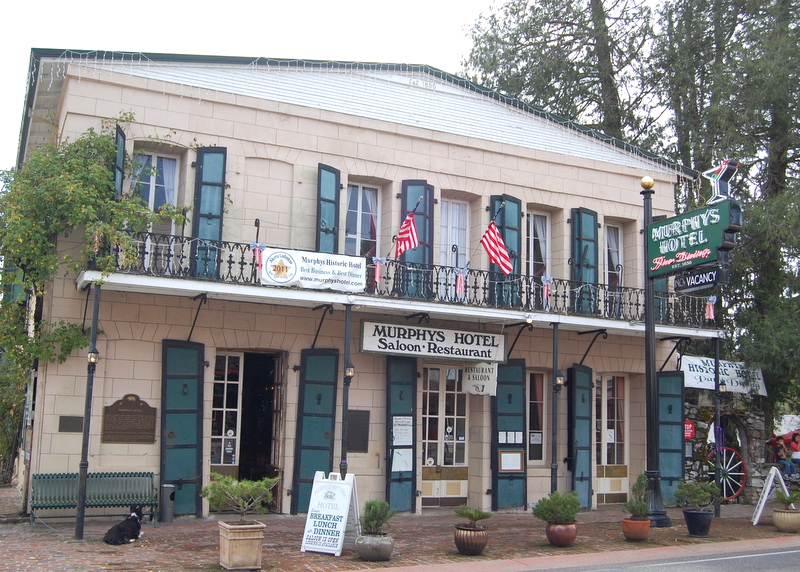
About this time last year I took a short road trip with a friend to Murphys in Calaveras County where early spring is a beautiful time for a visit, California's golden poppies providing splashes of color along the sides of Highway 4. The quaint little Gold Rush town is quiet, its sidewalks almost empty. Only locals seem to be around, going about their daily errands.
Murphys Hotel
I've always loved Murphys, which is one of California's best-preserved 19th century towns. The streets are lined with towering oaks and cedars. Handsome buildings from the late 1800s have been restored, but not to the point that they are unrecognizable from their Gold Rush days. The Murphys of today is a tourism destination, there's no doubt about that. It is full of wine tasting rooms, shops and boutiques. But they are tasteful and the town is not overrun with kitsch.

Several historic buildings have been turned into good restaurants, including Firewood, which has wonderful wood-fired pizza and Mexican food.

California's golden poppies
The saloon at the funky old Murphys Hotel is always fun, its creaky wooden floors where Mark Twain once walked are steeped in history, and no doubt more than one spilled beer over the decades.

For a little bit of Europe, there's Milfiori, an inn just outside of Murphys in the old mining hamlet of Douglas Flat. The atmosphere is more like Provence or Tuscany than hardscrabble mining town. There are lush, wide lawns and comfortable chaise lounges, hanging wisteria and pots of lavender.

Owner Willi Krauss, a Silicon Valley refugee, has created a haven in the restored 1860s farmhouse with three bedrooms and a wide front porch made for idling away a sleepy afternoon. A cozy little cottage rests near the barn in the back. Next door is the historic Pioneer Schoolhouse that dates from the early 1850s.
Milfiori Inn


The Italian Store
A couple of times a year, Willi unshutters the rustic stone building at the front of the property, the "Italian Store." Built in 1861 to sell goods to the legions of Italian and Welsh miners that flooded the area in search for gold, today it's a storehouse for antiques and collectibles.

This spring, the store's old iron doors will be opened April 28 and 20 for the twice-annual sale -- and chance to peak inside one of Calaveras County's many historic treasures.
Pioneer Schoolhouse, early 1850s

Tuesday, January 31, 2012

Gung Hay Fat Choy from San Francisco's Chinatown


San Francisco's Chinatown is really alive this time of year, bustling with energy and awash in bright red colors. Maybe because of the spectacular weather we've been having (sun, sun and more sun) and perhaps it's because we're ushering in the Year of the Dragon, but Chinatown seems more vibrant than ever.
The climax of all the festivities will be, of course, the annual Chinese New Year's parade, this year scheduled for Saturday evening, Feb. 11.
I recently updated by Chinatown travel app for iPhones, iPads and iPods, adding a few new restaurants. Two are especially wonderful if you like spicy food: The Potsticker on charming Waverly Place and Z&Y in the middle of one of the best blocks for eating in Chinatown, Jackson Street between Grant and Kearny.
You may have walked by The Potsticker over the years and dismissed it as a tourist spot. But last year it was taken over by new management (with staff from Z&Y). Head for the house specials such as filet of sole and any of the "Hot and Numbing Spice Pots," which you can ask to be prepared less fiery. The delectable and not-hot smoked tea duck is excellent.
Z&Y's fiery "explosive" chicken
The Potsticker's smoked tea duck
Z&Y restaurant also specializes in hot Szechuan fare. Try the kung pao bean curd with soft homemade tofu sprinkled with peanuts and onions. The signature dish is Chicken with Explosive Chile Pepper, an eye-catching plate that has diners digging through mounds of chile peppers to get to crisp juicy morsels of chicken (which are, amazingly, not very spicy). I loved the Tan Tan noodles, silky homemade noddles tossed with minced pork and vegetables. But there's so much more on the menu to explore.
For my updated Chinatown app, click here and look at iTunes for the download.
Gung Hay Fat Choy!
Follow me on Twitter: lauradelrosso

Monday, January 9, 2012

Treasure Island Flea Continues into 2012

Treasure Island has become the site of what must be one of the most scenic flea markets in the world. The event, called the Treasure Island Flea, is continuing in 2012.
For the first three months of the year the market is heading indoors, to the beautiful and historic One Avenue of the Palms building -- the last useable building from the 1939 San Francisco World's Fair.
The market -- called the TI Flea Pop-Up -- will take place the last Saturday and Sunday, 10 a.m. to 5 p.m. of each month from January through March.
For the rest of the year, the Flea will take place outdoors, on the lovely waterfront Avenue of the Palms pathway that offers spectacular views of the bay and San Francisco and is dominated by the massive curvy woman statue that was built for Burning Man.
Market dates are the last weekend of each month, from 9 am. to 4 p.m. each day.
I drove over to Treasure Island in late November to experience the Flea for the first time and wondered why I had waited to long. This is a fun weekend happening: there are all kinds of vendors, including antiques and collectibles, but also craftspeople and others who are clearly garage sale or junkyard scavengers with some interesting stuff to sell. Making it even more of an event are the dozen or so food trucks that participate. The organizers say in 2012 they are aiming to attract even more food trucks and create more food areas, perhaps even a "seafood grotto" with live shellfish.
Then there's the fun of being on the island itself. This 400-acre man-made spot in the middle of San Francisco Bay was constructed in 1936 and 1937 for the San Francisco World's Fair. It was considered as a site for San Francisco International Airport. For many years, it was U.S. Navy base. Many of those old military buildings remain, some now leased to businesses. A couple of wineries offer tasting rooms on Treasure Island, including TI Wines. Some old buildings are used for storage, including for the old Doggie Diner "hot dog" heads. It's also one of the best places to get a view the construction of the new eastern span of the stunning Bay Bridge. So, go enjoy, maybe buy something, but stroll and eat at the Treasure Island Flea.

Wednesday, October 26, 2011

India's Maharaja at San Francisco's Asian Museum


Jewel-encrusted belt
The throne room
Royal carriage
The Asian Art Museum has emerged from some troubled times with a snazzy new logo and energized strategy for attracting visitors to the world-renowned collection of art treasures at San Francisco Civic Center. The newest exhibit is the spectacular "Maharaja: The Splendor of India's Royal Courts," which runs through April 8.
I got a glimpse of it during a recent press preview and am making plans to go back: the galleries are filled with beautiful objects and descriptions of the fascinating history of Indian kingdoms and their rulers from the 1700s to the mid-20 century when British rule ended and it's worth spending more than just an hour.
The exhibit was organized by the Victoria and Albert Museum in London, where it ran from late 2009 to early 2010 and attracted 160,000 visitors, one of the museum's most popular Asian exhibits ever, according to one of the curators.
The 200 objects include elaborate jewelry, costumes and weaponry of the royal families and the royal courts in diverse Indian kingdoms. The first gallery is devoted to descriptions of the maharaja rulers and their ideal qualities and strict set of behaviors: not only were they diplomats and administrators but they were expected to be patrons of the arts. They were apparently real bon vivants: wine flasks and hookahs are inlaid with jade, rubies, emeralds, turquoise and gold. Their thrones were surrounded by exquisite textiles.
The history of the kingdoms and their evolution over the tumultuous 300-year period covered in the exhibition is well described. The British East India Company, which was drawn to India for its riches in spices and textiles, took over and the maharajas fell under British control by the 1840s. But the maharajas managed to maintain some authority and retain their riches and culture as princes as the British empire for several more generations.
The Asian Art Museum has a full calendar of performances, films, evening events and lectures scheduled to accompany the exhibit. Among them is a Nov. 13 screening of the documentary "Merchant Ivory's India" with a talk by Mills College professor Nalini Gwynne after the 2:30 p.m. screening (free with museum admission). Daily docent-led tours are scheduled from 10:15 a.m. to 3 p.m. each day.